Showing posts with label training. Show all posts

19 March 2020

What a year 2020 is shaping up to be!

The first few months into the new decade have been pretty funky.

I rounded into 2020 thinking that I wanted to take another stab at a 'fast' marathon ... and for me that means trying once again to go under three hours.  I wasn't (and still am not) sure about when that might happen, as none of the usual suspects in terms of spring races really caught my attention.  Mississauga has been a hit-and-miss kind of event for me, and while I've not really raced the Toronto GoodLife Marathon for myself (having participated in it twice - once as an unofficial pacer and once as part of a relay team) the prospect of having to run out and back along Lakeshore Drive wasn't tickling my fancy.  As such I have not yet registered for a goal marathon yet.

Turns out to have been somewhat serendipitous.

The onset of the COVID-19 pandemic has thrown just about everyone's racing season into turmoil, for both elite and recreational athletes alike.  Races have been cancelled or rescheduled, forcing some events to congregate on a crowded timetable (September and October this year are going to be k-razy for marathon majors), and people's training schedules have either been totally trashed or put on hold for now.

Even community run clubs have suspended their group workouts in order to encourage social distancing (and wisely so).

What's a runner to do in these tumultuous times?

Today I read this article from Peter Liddle that I thought would be worth sharing if like me you want to try to figure out the best (and healthiest) way to get through this upcoming running season: 
This is also another good read, providing some specific insights into just how the most disciplined and talented of runners are managing to keep it together (and in perspective):
#staysafe #socialdistancing #keephealthy #flattenthecurve
Share/Bookmark

30 March 2017

To jog or not to jog ... is it really a question?

I believe that there is truly a feeling of community amongst runners.  A recent viral video shows just how supportive and collaborative it can and has been:


It's also interesting to pick up on the subtle tones of judgment that sometimes rears it's ugly ahead within our tribe ...


Being someone who believes in and practices polarized training (keeping the majority stuff easy, the hard stuff hard and avoiding the 'mushy middle') I spend a lot of time getting in low-intensity jogs.  I'll tell you that it's real battle with the ego when you see other runners sweep past you while you're just thumping it out mile after mile, but I've long felt that the need for an easy run is usually a good indicator that I've really taxed my body well on the hard runs.  If I feel like I've got a ton more in my legs on my easy days that's a possible flag on the field telling me that I didn't give it my best on the hard workout days.

Anyway, just this week I've read two articles regarding two highly regarded and respected world-class runners - my hero Yuki Kawauchi and the recently-departed legend and multi-age group WR holder Ed Whitlock - and how they both found great value in slow-paced jogging.  I thought that both of these articles were worth sharing, so you can find them here:
While neither of these pieces will quash the smack-talk or debate regarding the potential benefits of the LSD (long slow distance) workout, hopefully it will encourage you to consider that perhaps jogging has its place in any runner's quiver.

And that jogger or runner - whatever the difference - we all belong.
Share/Bookmark

28 April 2016

Pound for pound

Have you ever obsessed about weight as a runner?

Feel like if you could only get to that 'wafer-thin' status you would fly down racecourses like an elite-level marathoner?

I sure have.

Even now as I prep for another race this weekend (my first running of the GoodLife Fitness Toronto Marathon, albeit as a pacer for a friend) I'm wishing that I was just 3-4 lbs. lighter.  Perhaps I'll get there for my goal marathon in Ottawa at the end of May - and if I do then perhaps it'll be thanks to some of these tips and tricks for tweaking my bodyweight.  Enjoy, and please let me know what you think!


Share/Bookmark

30 March 2016

From the P-Train to the O-Train

Caveat emptor - I am not a real coach.

Which may pose some real issues given that I am primarily a self-coached runner.

Over the last couple of training seasons I've been trying to work with a semi-modified version of the training plans available from the Old Mutual "Do Great Things" Training Centre.  The guides available via this web portal are geared towards those who are preparing to run specific races in South Africa (which clearly I am not ... at least not until such time that I apply to the Comrades Marathon) and are developed in consultation with accomplished ultramarathoner Norrie Williamson.  I do use the qualifier "semi-modified" as I tend to tinker with plans, usually adding in workouts to accommodate the group sessions that I run with my beloved RunNinjas.


https://www.facebook.com/groups/barrierunningninjas/?fref=ts

As our group normally has a 'workout' style run (e.g. fartlek, hill repeats, tempo) on Wednesday nights and more of a relaxed social run on Saturday mornings I decided that I would sneak my weekend speed work (which typically appeared on the training schedule for Saturdays) in before the 9 a.m. group run.  While not expecting anyone to join me I didn't want to exclude any of the RunNinjas so I put out an open invitation to the 7:15 a.m. "pain train" (as my buddy Steve affectionately called it), later to be known simply as the "P-Train".

Who knew that there would be other people crazy enough to tack on a solid workout (e.g. last weekend's 8x1000m @ 10k pace) ahead of a 10k easy run?

I've been blessed with the company of many great, fast and focused runners like Mike, Rad, Steve, Bill, James, Mark and Robert.  These guys all make me look bad, but at least trying to keep up with them forces me to draw from deep inside the well.

Which is where this story begins - and perhaps ends.

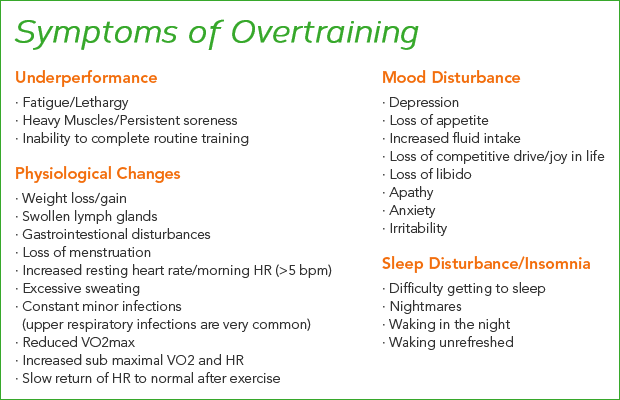
While it's been a great time every Saturday morning, the last week my body has been providing me with some unwanted feedback - as in I haven't been able to hit the paces that I've wanted for some key workouts (e.g. a 10k time trial and a 150 min. long run in particular).  This has elevated my level of concern as I began to wonder whether or not I'm treading a bit too close to the overtraining (let's call it the "O-Train" just to keep it all cutesy-wootsie) threshold.  


The thing is that while I feel like I can begin to check items off in the "Underperformance" category I'm not sure that many of the indicators are in play for me ... yet.  Of course I don't want to just keep on plodding down this track and eventually begin to recognize more and more of these symptoms showing up in my day-to-day existence.  Again, it's a fine line between pushing your boundaries out further (I've written before about training, recovery and supercompensation here and here) and stretching the elastic to the breaking point ... because once a runner has really crossed over into overtraining territory, it can be a long and arduous road back.

So maybe it's time to smarten up.  I may have been sabotaging my own training gains by pretending that I don't need to dial back as much as I probably do.

What's even funnier is that next Monday night I'm presenting a mini-workshop to the RunNinjas on essential training principles and periodization.  

Me, the non-coach who's booked a ticket on the O-Train but honestly doesn't want to take that ride.

Hopefully I can share some running wisdom while applying it to myself at the same time!

Share/Bookmark

22 January 2016

how to be the early bird that gets the worm!

recently i've had some of my RunNinja friends query me about how i manage to fit in all of the running that i do (and believe me, i don't consider myself as someone who gets in a lot of training week over week), and my normal answer is that as part of the 'covenant' that i have with my family i have to run on my own time and not interfere with responsibilities as husband and dad.  that means that five days out of the week i get up a few hours before everyone else, get my workout in and make sure that i'm home in time to make breakfast, pack lunches and see kids onto their respective buses.

what you need to know is that i'm not naturally a morning person - although i have always enjoyed the times that i've gotten up early in the morning for whatever reason, for most of my life i have been a nighthawk.  and who needs a snooze button?  i just used to set my alarm for as late as reasonably possible.

not anymore.  now being out on the roads when day breaks is a regular part of my routine - and my body has gotten used to waking up somewhere between 5:00 and 5:25am on its own, alarm clock or not.

some of you are cringing right now.


i've had many a conversation with runners who wish they could be up and at 'em before dawn but have no idea how to go about it.  well, this is my own feeble attempt at explaining some of the keys that have made it possible for me to transition from a late-nighter to an early riser..
  1. go to bed earlier - duh.  i realize that that for many people this is easier said than done - depending on the sleep schedules of everyone else in your house, the tasks that get left over for when there's finally some peace and quiet.  that's why i deliberately chose the word "earlier" as opposed to "early" - because i firmly believe that everyone can choose to be in bed earlier than they might otherwise be.  and if you begin to do this with some consistency you can begin to shift the expectations that everyone else around you has of you ... they will soon realize that if they want something from you then they will no longer be able to drag it out at their convenience and unload it on you at the very end of the day (when most people have their lowest energy levels).  and as for the tasks that seem to always wait to ambush you at the end of the day as well?  guess what - they'll still be there at the start of the next day, and the world will have kept on spinning in the meantime.
  2. get a better sleep - this also sounds a bit glib, but there are small things that you may be able to do to help with this.  you want to try to get a better sleep so that the hours that you spend in bed are quality hours, enough to refresh you so that an early start in the morning seems less like dragging your butt and more like being recharged and ready to fire up.  so here are a couple of ideas that might help with the quality of your shuteye:
    • a sleep mask - i've worn one every night now for the past two years, and just blocking out that extra bit of light helps me to get to sleep faster and stay in a deep sleep longer
    • melatonin - a natural supplement that aids in the sleep process.
  3. have a workout motivator - for me this is normally breakfast.  yup, all that i down before my morning run is a giant glass of water to help kickstart the metabolism and help with hydration, and that's it.  then i spend the rest of my run envisioning what kind of delicious breakfast i will make for myself when it's all over.  that has always worked for me, but it may not work for you - so maybe your morning motivator will be to find a fellow nut who will run with you and keep you encouraged and accountable.  a few winters ago i would get out with my friend rhonda-marie who often was looking for companions for her "stupid o'clock" runs.  you know what they say - misery loves company. 
  4. share your workouts - pride may go before a fall, but i gotta say that there's something about posting your early morning workout on social media or a fitness tracking site (like Strava) that will give you a sense of real accomplishment.  when you wrap up a solid run by the time that many people are still clearing the sleep from the corners of their eyes, you're bound to feel pretty good about yourself.  maybe good enough to do it all again the next day.
how about you?  does the morning running thing work for you?  if so, what tips would you have to share?  teach us all something in comments below!

Share/Bookmark

26 October 2015

we can rebuild him: the nuts and bolts of post-race recovery

here's my first training-based video on post-race recovery - i hope that it's helpful to any of you who have given it your all and are looking for the best way to be ready to go do it all over again!


if you happen to have any suggestions for a 'nuts and bolts' type training talk that you'd like me to address please add them in the comments below - thanks!
Share/Bookmark

15 October 2015

i'm ready for you, soweto!

except that i don't have a trip booked for south africa ... at least not this year (i still have my eye on you, comrades marathon!).

i've been using a training plan (structured by coach norrie williamson) specifically designed for the soweto marathon in preparation for my first attempt at the detroit marathon.  i chose to follow this plan as part of my 'mix-it-up' year where i deliberately focused on races that i'd not run before and using strategies (e.g. running without a watch at the waterloo marathon) that might stimulate/promote improved results.  i know that many runners choose to focus on consistency consistency consistency as the route to real gains -  but when it comes to personality that just isn't me, so why not go for broke?

as i get ready to step up to the start line in motown this weekend i have to say that i'm feeling very prepared to try to bump out a new 42.195 km PB.  i've been able to execute all of the prescribed workouts at the paces that i would expect to hit ... my body has held up and my weight stayed in a good zone ... and thanks to all my friends and training partners (much love and credit goes to the barrie running ninjas, the barrie roadrunners and the barrie trail running club) i feel as if psychologically i have all the tools to meet an audacious goal.

with that being said, i'm ready to disclose the goal(s) for this sunday's race:
  • 'A' goal - finish with a 3:00:00-3:05:xx time
  • 'B' goal - clock a new marathon PB
  • 'C' goal - run a negative split.

i've had the privilege of tapping into the wisdom and experience of a couple of speedy and accomplished marathoners (i wouldn't dream of not consulting the great stan ong who will be racing at the scotiabank toronto waterfront marathon, edging ever closer to his moose mug goal - and the other is my friend 'fast' bill steinburg) who have recommended that my best ploy at taking down an 'A' level goal is to try to run with a pacer and go for even splits.  i'd thought that perhaps i'd be able to adopt a similar strategy to the one that i used in waterloo of cruising through 32k and racing the final 10k, but the prospect of benefiting from the draft of a pace group has definitely got my attention.

so here at the precipice i stand, having controlled all that i can control.  now it's just time to enjoy the scenery and run my brains out!

#GOlikeneverbefore 

#ninjatakesonmotown
Share/Bookmark

06 August 2015

the life-altering perils of running

this week i had the privilege of speaking to a group of runners gathered for a symposium at our local MEC store.  the event was called "A Celebration of Runners" and it was organized by my pal and running sensei jim and the team at MEC Barrie.  while i felt completely inadequate and underqualified to be addressing such a diverse and experienced tribe of athletes (including my friend keith, a sub-3 marathoner and prolific 100-mile racer who was sitting pretty much front row centre) i shared a little bit from my own running journey in the hopes of providing some nuggets that might be encouraging or helpful to others who share this same passion/madness called running.  and in the hopes that some of this might be interesting or beneficial to anyone else, i thought that i would publish the substance of my presentation here on the rendezvoo point.

- - - - - -
i dislike running. really.

what i like is sleeping in.  i like KFC.  i like digging into a tub of ice cream and bowls of doritos after 10pm. i like not having to do the laundry every other day.  but since 2009 one of things that i've discovered about myself is that i was born to run – and more importantly, i like what my life has been like since i started running.

and yet it’s not without its perils.  i say that in all earnestness (ok, well mostly earnestness) because i think that as many of us here have discovered running is not just an activity.  it’s not something that you do, its something that has the potential to change your life.  some of the best stories about running are about people who have monumental turnarounds in their weight or health (physical and mental) as a result of taking up this sport.  yeah, it’s got that kind of impact factor.  it can and often does become so much more than just "going for a jog" or "lacing up the sneakers".  the best parts of it we can happily buy into and appreciate – and some of it can be like the force and have a dark side.

i want to share a quick list of  five things that i’ve discovered about what running has done to this human being with the hope that it might resonate with you – even if you haven’t found these to be true of your own running experience, i’m pretty confident that there are some takeaways that will benefit you in your own exploration and journey with running.


how i started into this running thing had everything to do with elvis.  i was cast in a community theatre production as an elvis impersonator, and specifically the version of elvis that appeared clad in black leather tip-to-toe in his 1968 comeback tv special.  the wardrobe person couldn't make the costume for me so she had to take my measurements and try to find the appropriate apparel items at the local thrift shops.  the leather pants that she found for me were definitely marked with the appropriate sizing tags but when i first tried them on they were practically painted on, and i pretty much had to have some fellow cast members help extricate me out of them.  but i was told that that was the best option available so it was my show outfit - and knowing that i had to not only don them performance after performance but also be able to dance around in them i determined that i had to lose some weight.

it was opportune then that my next-door neighbour should be trying to find a new home for his treadmill as he was in process of a downsizing move to a new house - i volunteered to lighten his load and put the treadmill in my basement in behind my computer workstation.  when i first started running i would throw a music video on YouTube and just try to last through the 3-4 minutes ... and as they say, that was the beginning of the end.

given that i started running to lose weight, it's been an issue that has taken up a bit too much of my attention during the past couple of years.  it's not often spoken about - at least not in circles involving the male of the species - but weight issues can be a bit of a struggle amongst focused runners (there are two great articles that i would recommend that can be found here and here).  i for one have found myself at times consumed with desire to lose weight in order to gain precious minutes in the marathon, having read that 1 lb. lost can equal 1 min. shaved off of a marathon performance.  but it's something that can be easily obsessed over - and while it may prompt healthier eating in terms of choices and plate portions, one of the things that i've come to realize and accept is that there are all sorts of different body types and that your ideal racing weight is the weight that you race and feel your best at, whatever it might be.  fuel and train smart and let the results speak for themselves - not the bathroom scale.


in the bible, specifically the old testament/hebrew scriptures, exodus 22:22 says "don't mistreat widows or orphans."  i don't know about your family situation, but my wife is a running widow and my kids running orphans.  don't get me wrong - i love what running does for me personally and the great community of people that i've been introduced to and the new friendships and bonds that i've struck up with others who take to the roads and trails alongside me.  it's just that we each have a set or primary/priority relationships to which we need to stay attentive.  one of the big reasons that i'm an early morning (i.e. pre-dawn) runner is so that i do not shirk my responsibilities at home, which may or may not include getting kids up and out of bed, helping with lunch bag prep and/or serving breakfast. 

i wish that my family shared my degree of investment in running - my wife will take to the treadmill on occasion and has been out for two short runs with me.  as for my kids, aside from participating in the girls on the run/move program at their schools they're not much for running ... so this year when they asked me what i wanted for my birthday i told them that i wanted to run a 5k MEC race with them this fall.  they've indulged me on this - now i just have to get them out the door and training so that they don't show up at the start line with the look that says "what am i supposed to do now?".

so in your efforts to go the distance with running make sure that you don't lose the relationships that matter most along the way.


as far as my running is concerned i like to have structure.  since i haven't yet discovered the pure joy of running, i'm motivated by races and PBs - and to be able to put out my best i rely on training plans.  i've used everything from your base-model plans easily found on the interweb to a customized plan crafted for me by my former running coach rick ball.  the benefits of a training plan is not only the structure that it offers but also that it will (if it is thoughtfully and purposefully designed) incorporate different workouts intended to stimulate various adaptations and systems, including but not limited to speed development, fat-metabolizing runs, hill training and recovery runs.

the dark side of training plans is that they can become cruel and unyielding taskmasters ... if you let them.

i remind myself frequently that the training plan is meant to serve the runner, and not the other way around.  it's easy to become 'enslaved' to a training plan, which is different than being committed to one.  commitment recognizes that training plans are useful for pushing you beyond your comfortable limits, and making you fitter, stronger and faster by extending your boundaries.  on the other hand enslavement happens when you or i look at the training plan and try to punch out each workout no matter what - the adverse/dangerous weather conditions, extenuating circumstances (e.g. sleepless night because of kids or special social events), accumulated stress, nagging/emerging injuries.  it's more important to be well attuned to what your body and life circumstances are trying to communicate to you than it is to be able to cross out a scheduled workout on the calendar.  

remember - the dog wags the tail.  the tail doesn't wag the dog.


i have a couple of running friends whom i would consider 'colleagues' in the sense that we started running in and around the same age, are similar in physical build and training habits and overall fitness (i.e. with respect to general activity and injuries).  however, a few of these colleagues of mine have turned in blazing fast times in distances from the 5k through the marathon - the kind that i could only wish for, and i'm left wondering at times 'what's wrong with me?' 

this characterizes a dangerous (and fruitless) pursuit that i'll affectionately term 'the barbie complex'.

you know barbie, right?  the doll from the 1950s/60s that has become iconic not only because of it's dress-up versatility and playability with girls of all ages but for the fact that if she were a real person her proportions would make it physically impossible for her to walk upright or keep her head from flopping over?

and yet she has somehow become an image of feminine perfection, and the object against which all others are compared.

the barbie complex is all about comparing yourself to those around you - which in a certain light can be helpful because we can help sharpen one another in terms of knowledge and execution.  we can and often do push one another to be better.  the thing is that there will always be someone faster than you, and almost assuredly there will be someone who is slower than you.  getting caught up in a game of comparison can be a vicious cycle because you are uniquely you whether in terms of genetics, running history, life circumstances and raw potential.  if you're going to compare yourself against anyone make it against the person that you were yesterday or last week or last month or last year.  a worthwhile goal is to be focused on becoming a better version of you than you were before ... and lay all of the other comparisons to rest.  you'll be happier and easier to get along with that way.


as a rabid introvert these ^^ are my favourite running companions.  that's why i love getting my workouts in before most people's alarm clocks ring, and having the opportunity to disappear out on some rural concessions.  since i live with five women (my wife and four daughters) there tends to be a bit of 'verbal activity' that happens around my place, so running affords me an arena where i can embrace the silence and engage the recharging process.

that doesn't mean that i'm out and out anti-social - in fact, one of the things that i've loved about becoming one of the barrie running ninjas and participating in the MEC group runs is the opportunity to generate new connections, build bonds of friendship with like-minded people and to learn from and be interwoven with intriguing life stories.  what i've discovered is that the running community is an extremely generous one - with most individuals willing to share their time, experiences, accumulated wisdom and even tangible resources with others.  in particular i've found that the MEC running groups encourage a culture of community and not competition - it's not about who can go the fastest or furthest, but about how we can nurture one another to be the best that we each can be ... and wholly enjoying the relational development along the way.  this is the kind of accountability that is attractive and that i will happily buy into ... even as a rabid introvert.

Share/Bookmark

07 July 2015

ain't no mountain high enough ...

it's almost time to get crazy.

with less than two weeks to go until The North Face Endurance Challenge Series GORE-TEX® 50 Mile trail race i'm into full-on fat-loading and taper mode.  so far for 2015 i've logged over 2800km in workouts, a good proportion of that i would consider as build-up for this ultramarathon.  i've gotten in my interval work, long runs, hill sprints (up and down), and time trials.  aside from a few short-lived knee issues i've managed to stay injury-free and post several encouraging race times that lead me to believe that i'm in good shape to be able to complete this event upright.

which means that it's now also time to start thinking about goal-setting.

i've said from the outset that since this is an entirely new distance test for me that my #1 objective in this race is simply to survive it.  however, to be fair that goal was originally considered against the context of my experience running 56km in the 2014 limberlost challenge where i felt like i was trudging through the valley of the shadow of death.  now, having finished my 50k at sulphur springs in a much more encouraging time i feel like i want to be a bit more ambitious (without being presumptuous).

so once again with the intention of having the small circle of people who read this blog hold me accountable, here are my three goal levels:
  • 'A' goal - finish within top 10 for my age-group
  • 'B' goal - finish in between 8:30-9:00 hours
  • 'C' goal - finish and stay out of the medical staff tent.
there you have it!  for now i'm going to be eagerly watching the weather forecast to see just what kind of ambient conditions we'll be facing that day and trying to nail down just which pieces of gear i'll be using.  i know for certain that i'll be wearing the skechers GORun Ultra 2 and using my nathan quickdraw elite handheld and princeton tec remix headlamp, but it's still up in the air whether or not i'll be wearing the original SPIbelt or a bottle-less ultimate direction AK 2.0 race vest to carry nutrition.

and there are still spots available if you're interested - register online and don't forget to use the promo code D30PVON15 for a 15% discount on any race distance!
Share/Bookmark

11 February 2015

“when nothing is sure, everything is possible.”

a little while ago my attention was piqued by the premise of a book called Antifragile.  steve magness had alluded to this book in one of his blogposts that i'd read from late last year and immediately i was intrigued by the notion that organisms and entities can benefit by deliberately exposing themselves to uncertainty, risk, adversity and change.


in many ways this is a mantra by which i tend to live.


however, it's not something that i'd thought to put into practice with regard to my race training regimen.

don't get me wrong - there's variety in my schedule.  for one, i don't run on the treadmill, so stepping out the door each and every day (regardless of lighting, ambient air and/or windchill temperature, traction conditions, and accumulated amount of precipitation) provides me with multiple route options.  still i will admit that i have 6 or 7 'favourite' paths to cover depending on the targeted workout (e.g. tempo run, interval training, hills).  i suppose that everyone has some tried and true standbys that they go to when tackling a particular type of run, partly because we are by nature creatures of habit.

and yet, if we do consider the thesis that athletes who race in variable conditions (e.g. weather, course undulation, fatigue level, susceptibility to injury, nutritional demands/processing, adherence to race strategy) benefit more by training in non-linear/predictable environments then we'd do well to seek out curveballs in our workouts.

i know that that this may seem like an unsound training approach.  my former running coach would have cringed at the thought of mixing up workouts in this way - his view was that improvement was best measured in an apples-to-apples kind of situation, so all interval workouts should be conducted on a standard 400m multi-lane track.  without those kinds of standardized metrics his opinion would have been that i'd/we'd have no idea where my fitness and speed levels really resided.

and yet there's something to be said for each person knowing their own needs and design best.  i'm certainly not adverse to change (what nassim nicholas taleb would deem 'fragile'), and i'm not even someone who just built to withstand the rigours of change and adversity (taleb's definition of 'robust') - but i'd consider myself a person who seeks out new challenges, new experiences and new expressions - quite potentially an 'antifragile' personality.  as such, i'd be more inclined and perhaps adept at actively engaging diversification across workouts - even those covering the same distances and intensities.


believing that this type of tactic jives with me, what has that looked like?
  • tempo runs that are not on the flats, but that have taken me out into the countryside on routes that had previously been reserved for long and/or easy runs 
  • long and/or easy runs that do not follow a loop course but that rather meander down city streets, exploring neighbourhoods that i've never wandered through before
  • hill work that varies from 10s steep (12%) hill sprints to 6% grade 30s hill repeats
  • pre-dawn runs that are sometimes preceded by a snack, sometimes by nothing
  • some runs gauged by pace, some by heartrate, others simply by feel.
i realize that this is not earth-shattering to most of you, but for me it is reflective of my attempt to become more and more #antifragile.

how do you mix it up - if you choose to do so at all?

Share/Bookmark

05 December 2014

from good to gooder

december often poses the opportunity for a year in review, and casting a vision for the future.  so i figured that this is a good time to re-tool.

i'm deluded enough to believe that with each passing year i can become a better and faster runner - even though i'm well into my 'masters' era.  with that in mind (and having just finished reading through pete magill's build your running body) i am incorporating a few changes to my race preparation regiment.  these changes include:
  • strength work - for the last few years i've basically lived by the credo that in order to become a better runner i need to ... run.  more.  and after that, run.  at this point, i think that i could definitely benefit from some focused strengthening exercises, and in particular squat, lunge and plyometric work.  i have a dayjob that has me sitting at a desk in front of a computer for hours on end, so i'm pretty sure that i have weakened glutes - nevermind horrendous posture.  while i've been consistent over the past five years with bodyweight exercises for my core and upper body, i have neglected anything that might induce additional fatigue for my legs.  again, thanks in some part to pete magill i've concluded that by developing some of these key running muscles (e.g. glutes, hamstrings) i'll not only be contributing to injury prevention but enhancing the horsepower of my running engine and lengthening my stride.


  • establishing race weight early - while i consistently get the "put some meat on your bones!" comment, i know that between my obliviousness to my weight over the last few years and naïve belief that running would counteract my penchant for late-night ice cream and doritos i've probably carried more than my fair share of pounds into each race.  i've determined that i want to hit a race weight of around 135lbs (and at 5'9" that would situate my body mass index at 20, well within the normal range), and that the best time to establish that is during my base phase training.  when i hit the next phases of race preparation i will likely be eating a bit more to ensure proper fueling and recovery, so getting to where i want to be at this time will set a good start point and will likely be simpler to maintain (than trying to lose pounds in the late stages of training in order to achieve race weight).

  • intentional increase in stride rate - i'd tried counting my strides-per-minute (SPM) rate before and landed in the 170 ballpark.  after a few article reads (like this one and this one) i thought that it would benefit me to pick up my feet a little faster, and to try to stay lighter on impact.  just making that mental decision has resulted in currently working on about a 190 SPM rate.

  • minor changes to running form - i confess to being a tinkerer.  maybe it's because i'm a visual learner, but i tend to try to model my technique in sport from watching others ... i've done it with tennis, volleyball, basketball, golf, and now running.  while i'm sure that what results looks nothing like the athletes that i try to mimic (e.g. michael chang, karch kiraly, isaiah thomas, karrie webb) i do try to emulate the form positives which helped each individual excel in their respective fields.  for 2015 the adaptation for me in running will be to try to swing my arms a little more like mary keitany - towards the midline, and a little less agressively forward and backward (like the motion of the side rod on a train locomotive).  i believe that it is a more efficient motion in terms of energy expediture and reduces unnecessary torsion while maintaining momentum (for more on this i recommend reading this article and this one).


  • dietary tweaks - as part and parcel of reaching race weight, i've been reviewing the quality of the fuel that i've been stuffing into my system.  i've substituted more fresh fruits and veggies into my meal recipes, as well as swapping out your econo-spaghetti for whole grain or brown rice pastas.

  • training plan - two years ago i tried preparing for a marathon with the online version of the Hansons marathon training plan that i found ... and while it did get me to a new PB at that time, i wound up leaving it behind due to how tough i thought that it was to maintain a six-day-per-week schedule of cumulative fatigue mileage.  since then i've gone on to, well, maintain a six-day-per-week cumulative fatigue mileage sort of schedule.  so now that i actually am reading the actual Hansons Marathon Method book (review to come!), i'm back on track with their approach and am eager to see how well it conditions me this time around.

how do you find that your end-of-training year time is best spent?  are you a tinkerer?  if so, on what kinds of adaptations do you tend to focus?
Share/Bookmark

13 November 2014

why you (and i) need a real off-season

this has been a banner running year in so many ways.

BQ.  

first ultramarathon (56k).

first trail race.

first time guide-running.

first official pacing duties.

first adventure race.

most distance logged in a calendar year (4385km YTD).

and now, it's time for a rest.

if you're at all the kind of runner that i am, then you know how much easier-said-than-done this is.  one of the strengths of my training cycle has been just how disciplined i've become at getting out the door six days a week.  rain or shine, wind or hail, polar vortex or humidex alert.  it has been as natural for me to complete a daily (or two-a-day) run as it has been to eat dinner.  if anything i've only taken a pass twice all year long on my scheduled runs - both of them occurring within the past five weeks on account of knee pain (and quite possibly an indicator of overtraining).

and yet for having achieved this series of accomplishments for 2014, you'd think i'd be more than ready for a break.  you'd be wrong.

however, knowing that even the very best, most dedicated athletes in the world take a block of time away from their sport as an important component to their training was incentive enough for me to at least consider it.

as best as i understand it, the following are the benefits to a true multi-week break/off-season from running:
  1. physical rest - this sounds blatantly redundant, but the fact is that a year's worth of running and racing takes a cumulative toll on the body in the same way that that cumulative miles actually develop your running form and lead to physiological adaptations.
  2. mental rest - my friend jim has repeatedly said that running is 90% mental and the other 10% is in your head.  if that is the case, then your brain needs as much of a respite as any other part of your body.  all of that focus, that rugged determination, that visualization needs to take a pause and recharge so that when you need it it's still there, not worn out and fuzzy.
  3. treat yourself - maybe this is the time to sneak in a few of those delectable goodies that you diligently said 'no' to during your training cycle or perhaps to the occasional less-than-ideal runner's meal.  although we make sacrifices to train that doesn't mean that the remainder of your life has to become this relentless penalty box session.  you might also take the time to sleep in some more and find out what it's like to not constantly feel fatigued.
  4. take inventory and set new goals - this is a great time to step back and look at all that you've accomplished, regardless of whether or not you hit the mark on each and every race target.  and given that absence makes the heart grow fonder, each and every day of non-running will bring you closer to that place where you are absolutely itching to hit the road or trails again.
  5. re-tool - if you're a triathlete, adventure racer or obstacle race competitor then you probably already spend time cross-training.  for running-specific people like me this is a time to check out other exercise disciplines, or hone in on some strength-building work.  if you're a reader, you can use this time to educate yourself on some of the technique and finesse points of becoming a more finely tuned machine - i recommend steve magness' the science of running and pete magill's (with thomas schwartz and melissa breyer) build your running body.

convinced?  i admit that this is just as much of a chore and a discipline to stay out of my running shoes as it is to lace them up on bone-chilling blustery pre-dawn winter mornings ... but i believe that this is also the smartest move and well worth the investment of two or three weeks for my upcoming race year.

what's your take on an 'off-season'?  how do you rejuvenate your running?  i'd love to learn from your insights and experiences ... please leave a comment and tell your story!
Share/Bookmark

25 March 2014

crunching the numbers

i'm more of a process over product kind of person.

journey over destination.

quality over quantity.

people over project.

which is all kind of funny when i think about how preoccupied i am with tracking my training data.

with so many options out there, my favourite tool for keeping tabs on my weekly mileage is dailymile (you can see the dailymile widget on the left-hand side column on my blog).  i suppose that it's because it's a combination tracking site and social media platform, including the option to link up with friends/acquaintances and post comments, encouragements and other notes.  it provides me with just what i need in terms of at-a-glance data:  distances for specific workouts, for a week or month at a time - even what some of my colleagues are managing to pump out on a weekly basis.  


this may or may not be a preferred performance tracking and analysis tool for runners, but many of the athletes that i follow on twitter and facebook have a profile on dailymile.

many others have taken to sites like strava or runkeeper, and to a lesser degree training peaks and sporttracks.  again, there are all sorts of alternatives available, and many times i've found individuals to be fiercely loyal to their webpage of choice.

since i use my garmin 305 to record my run data, my first digital stop is normally at the garmin connect website.  so imagine my intrigue when i was reading alessandro santuz's blog and found out about tapiriik, an open-source platform for synching multiple performance tracking service streams.


what's great about this is obviously the concept of synching - one touch consolidation of information across multiple software applications.  instead of being daunted and/or bogged down by the work of logging into various profiles and inputting information separately into each one, tapiriik offers you the ability to set-up a synching network and then subsequently making your training and racing stats available in each one.  

the one notable feature of tapiriik that is especially enticing is the ability to synch to dropbox, a virtual (shared) hard drive.  while i'm still working at configuring this so that it works optimally for me, i relish the thought of being able to have a downloadable capture of my training info for my records.

which tracking service have you sworn allegiance to, if any?  do you think that a tool like tapiriik might be of use to you?
Share/Bookmark

03 March 2014

discipline and the hurt locker


on a recent group run our 'leader' commented to me that he thought that i would surprise myself at how well i could compete in ultramarathons - partly because of the distances that i was covering in training (the week prior to our conversation i'd hit 121km/75mi) but also because of the discipline that i had in including various speed workouts and recovery days.

it reminded me of the conversation that brought me into a relationship with my coach last year - he also mentioned that he was willing to take me on because he recognized that i was disciplined enough to put in the requisite work.

whenever i hear this said of me, i'm encouraged.  

i'm also reminded not to distort the meaning or let it go to my head.

this past saturday i put in what i would consider a really tough 34k run on horrible road conditions - 10-15cm of moderately soft snow in sub-freezing temperatures.  

it felt like running through beach sand the entire way.

while i prided myself on completing the day's run, some of my joints decided to voice their displeasure with me later that night during my sleeping hours - in particular my knee.

once before i'd had this nearly unbearable pain running up the medial side of my left kneecap while lying in bed.  i couldn't stand to bend it, and i couldn't lie on my side in a way that applied any pressure to it.  it was discernibly swollen.

yup - sounds like an MCL (medial collateral ligament) sprain.  


i've had this experience once before - about four months ago, after running my first ever double workout day.  then i thought that i'd just gone out too hard in my second run.  this time i think that it was the combination of unstable terrain and breakdown in form over the course of a long distance.  regardless, it left me hurting.

the thought of having to take an unplanned rest day was far from appealing - besides, i'm 'too disciplined' for that!  but i've also learned that being disciplined is about recognizing that sometimes your body is screaming at you to pay attention - a different sensation than it nagging at you to just give it up already - and that doing so is just as important as inputting more miles into the garmin.

as such, i've banked an extra day off yesterday and taken my normal rest day today.  it feels like a mini-vacation, but last night's sleep felt like a million bucks compared to the night before - plus all swelling has disappeared and there's no residual pain standing, sitting or climbing stairs.  the plan is get back at it tomorrow.

so do you think that i'm a wuss?  would you have gutted it out where i turned back?  or do you think that i'm a numbskull for launching myself back into the fray so quickly?  

i'm no M.D. (or even B.Sc. for that matter!), so all this self-diagnosis is sketchy at best.  but i must say that i feel good about being able to deviate from the training plan with time off and not feel like a traitor.


Share/Bookmark

20 February 2014

from a guy who don't know nuthin' about nuthin'

being still what i would consider a novice runner (having started into this in my late, late 30s) there's so much that i know that i still don't know.  i make all of the rookie mistakes (e.g. going out too fast in races, not recovering properly after training runs, spastic breathing patterns, a stride cadence of who-knows-what) and feel like i'm a sponge every time an article comes out in competitor magazine.  


with that in mind, from time to time i realize just how many insights and tidbits i've picked up since developing this running obsession.  one of my strengths is connectedness, which i understand to be an aptitude for understanding links between events, experiences and information.  

in one way that means that i'm a walking treasure trove of trivial knowledge.

but it also means that if you need it, i can direct transfer some of that knowledge your way.

case in point:  my friend lewis is prepping for his first ever half-marathon race this april.  this week he decided to share with me something of his homebrewed training plan with an invitation to comment on it.  to his credit it had the right mix of variable workout elements:  long runs, speed intervals, race-pace runs and recovery days.  i know that the first plan that i used for half-marathon training simply laid out distances to be covered on any given day without any real description or prescription as to intensities appropriate for that workout.

my first bit of feedback to lewis was about the fact that he was plotting hard workouts (e.g. race-pace runs and tempo days) back-to-back.  here's how i responded to that:
i think that putting a race pace workout back-to-back with a tempo workout is either (a) a recipe for injury or (b) an almost guaranteed less-than-optimal tempo workout.  i think that almost any workout plan that you can find prescribed by a coach or a training program will not put key workouts like this adjacent to one another - the idea being that your body needs an easier day between speed-focused runs to recover and build on the gains from that workout.  also keep in mind that the tempo workout should be at 10-20s/km faster than race pace - if you can pull that off after a decent race pace day, then your race pace might be too generous.
i followed up that bit of sage advice (anybody familiar with sarcasm?  anybody?) with a question about his end-of-week workout which simply denoted "Run-Intervals".  when i inquired about what distance he was using for intervals - wondering out loud whether or not he might be using 800m or 1km - he came back letting me know that he was thinking more like 80-100m.  once again my fountain-of-misinformation mouth decided to spout:
so here's my challenge - to stretch out those distances so that you get a true 'interval' session. what speed training does is to (a) improve your running form as form tends to break down when running at slower speeds; (b) develop fast-twitch muscle fibres which are important for later stages of a race; and (c) aid in mitochondria development (both in terms of volume and density) which is important because it's mitochondria which help your body convert carbs and fat into energy.

the 50 or 100m sprints are more what i would consider as 'strides' - short bursts of speed which help to loosen/stretch the leg muscles but do little in terms of grander-scheme development. i would recommend trying at least 400m but optimally 800m intervals (with 90s-120s jog/walk breaks in-between sets) to really get some benefit out of the speed training.
i'm about 85% confident that what i'm sharing is accurate from a science/exercise physiology standpoint - and 95% confident that these comments can be helpful to him as he reviews his progress and the path to the start line.  but the fact that i've no formal education in science (unlike my friend stan - now there's somebody who knows what he's talking about) and that i fumble about in my own training makes me worry that i'm just offering a load of balderdash. 

i don't purport to be a coach of any kind.  

i hope that i'm not leading my friend lewis astray.   

all i can say is that the running community (online and otherwise) as i've experienced it is incredibly generous with their sharing of information and trial-and-error stories.  i know that i've benefited from tales told on the run, and i want to be part of that pipeline rather than behaving like a bottleneck or a blocked valve.  

please feel free to correct me (especially since i can pass it along to lewis!) if my advice seems askew - and let me know how you've maybe helped to encourage/coach/inform somebody else on their own running journey!


Share/Bookmark

14 February 2014

how (s)low can you go?

"i am both poles and the equator, with no temperate zones in-between."  ~ e.k. hornbeck in inherit the wind

coaches and good training plans all mark out various types of runs that you can and should complete in preparation for a race.  terms like "aerobic", "tempo", "long run", "race pace", "fartlek", "intervals", "recovery", "hill work" and others usually help to describe variations in duration, intensity and sometimes terrain that contribute to improved conditioning.  while this may all come across as elitist jargon or technical mumbo-jumbo, one of the important takeaways is that for a runner who is focused on making real gains there has to be attention given to specific types of training.

like many runners, my ego has gotten in the way of properly strategizing my training runs and for too many training cycles i believe i've fallen into the trap of running mainly in the mediocre (or medium effort) zone instead of making 75-80% of my runs easy and the remainder medium-hard to hard.  every easy run that i took i felt like i was losing ground - or at least speed - and convinced myself ever-so-subtly that i needed to push it just a bit faster.  i figured that if somehow i could increase my baseline speed for an easy run to something faster, then that would naturally make my hard runs even more impressive.


as logical as that may (or may not) sound to you, i should have paid attention to the fact that even the best runners in the world know the importance of taking it really easy on their easy runs.  i recall reading sara hall's blog entries while training in kenya about just how slow these kenyan running machines take their runs - a pace that would even seem über-relaxed to a hack like me!

the main idea is to log your easy miles easy so that when it comes to logging the hard workouts you can really put forth a high-investment effort.  when the easy runs drift toward the faster side, your body's fatigue levels can act like a magnet and pull your hard runs toward the slower side, reducing the magnitude of super-compensation


there are all sorts of good articles out there about the 'hard-easy principle' of training, and two that i found interesting are here and here.  there's also a very good article that addresses how to fine tune the spectrum of training runs here.

so how easy do you take it on your easy runs?  for me right now it's about 5:45-6:00/km, and that's counterbalanced with race pace runs at 4:27/km and speed intervals at around 3:40-3:45/km.  would love to hear back from you!
Share/Bookmark

27 January 2014

much ado about junk

they're often referred to as 'junk miles', and many times come with a warning.  too many junk miles and you risk overtraining.  or at least unspecified, undisciplined training.  numerous articles have been written about the perils of tossing in junk miles into one's training regimen - and interestingly enough, various rebuttals offering a different point of view on what actually constitutes these 'junk miles'.

in essence, i've come to understand 'junk miles' to be additional or extended workouts without any real perceived workout purpose that interfere with the athlete's ability to successfully tackle prescribed training tasks.  

the problem that junk miles present is that they are often used to pad not only a weekly mileage total but the runner's ego.  while races create the situation for a competition for the fastest time, training cycles can create the situation where individuals compete for the most miles (or in my case kilometres) logged.  online trackers like dailymile, runkeeper and strava can feed that competitive nature by posting analytics on your social media outlets as a means of teasing, taunting or challenging your friends.  while good 'king/queen of the mountain' feelings may result, the collateral damage is that when it comes to hard, speed-based workouts the energy and effort may not be there because resources were deployed to satisfy inflated distances.

now coming from a loosey-goosey, stream-of-thought kind of person like me you might be surprised to hear that i'm a fan of structured training.  having used training plans from the hansons and ryan hall i've now found that i like to have a program to outline the different types of workouts (e.g. tempo runs, easy/recovery days, speed intervals, hill sprints, race pace) that i need to build into my cycle.  however, also having read matt fitzgerald's book run i've come to believe that there's nothing wrong (and everything right) with listening carefully to feedback from your body and adjusting any training plan on the fly.  
since i feel like i have the freedom to tinker, and having gained a sense that i do flourish under higher-mileage training conditions, i do tend to add the odd kilometre here and there as well as tossing in the occasional double (aka second training run in a day) or workout on a scheduled off-day.

rationale?  (or in a more declaratory tense, "irrational!"?)

two reasons:
  1. one of the primary principles driving the hansons marathon method is that of cumulative fatigue, which suggests that (successfully) executing hard workouts on tired legs not only nets greater muscle/aerobic/mitochondrial gains but also simulates the late stages of the marathon - thereby preparing you to be able to overcome the dreaded 'wall'.
  2. in run (and other articles) matt fitzgerald alludes to the fact that time spent practicing the running motion improves communication between the brain and the muscles - this is all about developing skill through repetition.  appreciating this helps me to see that the more kilometres (over months and years) that i log will refine my muscle memory for efficient running form - as long as i'm not running in such a fatigued state that my running form breaks down.
so while some might consider these 'junk miles' for me since they are not included on the 'printed' plan, in my estimation the extra kilometres and/or easy runs are not entirely without purpose.  

if you'd like to check out more on this junky debate, here are a few resources worth reviewing:


Share/Bookmark